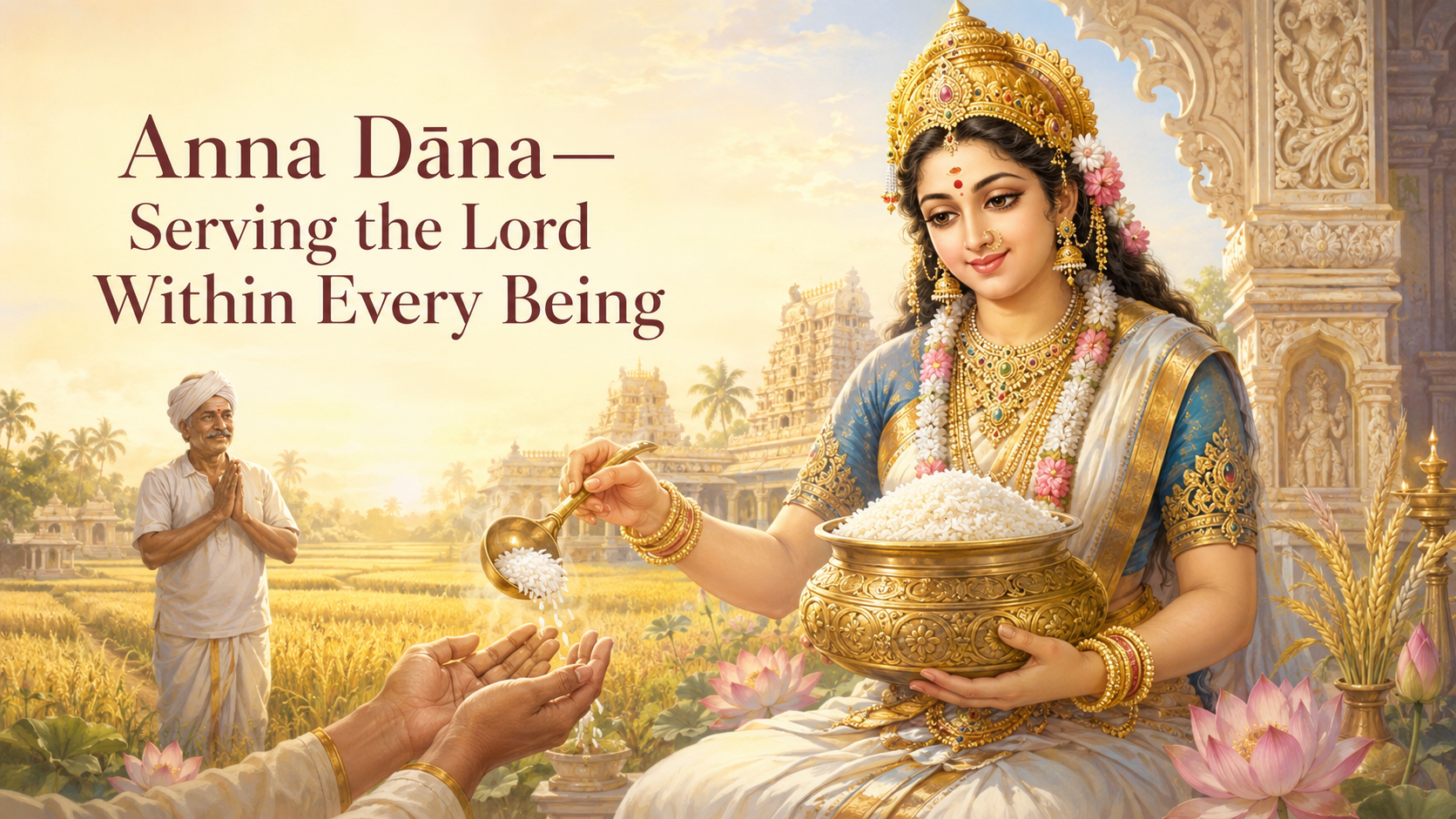
Anna Dāna—Serving the Lord Within Every Being
॥ Hari Sarvottama Vāyu Jīvottama ॥
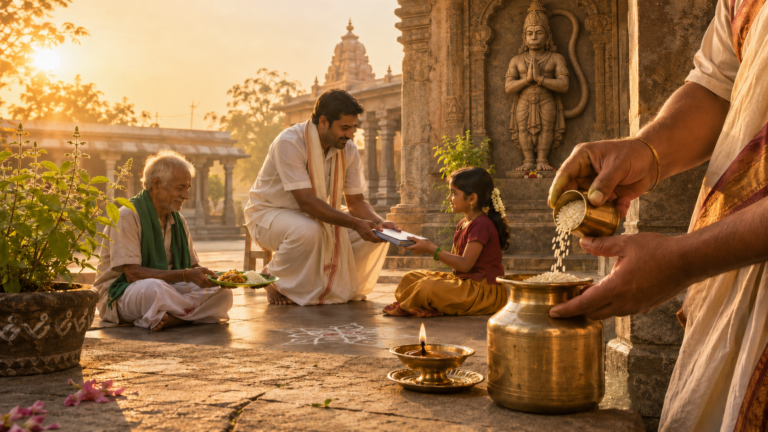
When Food Becomes an Offering
Dharma Dīpikā – Dhana–Dharma Yātrā | Article 5
Hunger is among the most immediate needs experienced by every living being.
A person may postpone purchasing new clothes, set aside a desire or endure temporary discomfort—but hunger demands an answer. When food is offered to one who is hungry, it does not merely become a material gift. It brings nourishment, relief, dignity and life itself.
This is why Anna Dāna—the offering of food—holds a sacred place in Sanātana Dharma.
Annam Is Sacred
The Taittirīya Upaniṣad instructs:
अन्नं न निन्द्यात् । तद्व्रतम् ॥
Annaṁ na nindyāt. Tad vratam.
“Food must not be treated with disrespect. Let this be one’s sacred observance.”
— Taittirīya Upaniṣad 3.7
Food is not to be dismissed, wasted or regarded carelessly. It is one of the principal means through which Sri Hari sustains embodied life.
The same Upaniṣad further declares:
अन्नं बहु कुर्वीत । तद्व्रतम् ॥
Annaṁ bahu kurvīta. Tad vratam.
“Let one produce and provide food in abundance. Let this be one’s sacred observance.”
— Taittirīya Upaniṣad 3.9
The teaching extends beyond respecting the food placed before us. It asks us to cultivate the capacity and willingness to ensure that food is available to others.
Thus, feeding another is not merely an expression of generosity. It is participation in the divine order through which life is nourished.
Annadātā Sukhi Bhava—May the Provider of Food Be Happy
Before food reaches our plate, it passes through many hands—most of which we may never see.
We may not know the farmer who prepared the soil, sowed the seed, waited for rain, protected the crop and finally harvested the grain that nourishes us. We may never meet the people who transported, prepared and served it.
Yet their labour is silently present in every meal.
The traditional blessing:
अन्नदाता सुखी भव ॥
Annadātā sukhi bhava.
“May the provider of food be happy and blessed.”
is therefore more than a courteous expression. It is a prayer born from gratitude.
The annadātā may be the farmer who cultivated the food, the person who prepared it or the one who offered it to us. Remembering them with thankfulness protects us from taking food for granted.
Even when we cannot personally thank the farmer, we can carry a quiet prayer in our hearts:
May the hands that produced this food be blessed. May their homes be nourished, their efforts bear fruit, and their lives be filled with well-being.
Such gratitude makes the act of eating more mindful. It reminds us that every grain contains unseen effort and that our nourishment is connected to the labour, sacrifice and cooperation of many lives.
To respect food is also to respect the annadātā.
The Guest Must Not Leave Hungry
The Taittirīya Upaniṣad gives the celebrated instruction:
अतिथिदेवो भव ॥
Atithi devo bhava.
“Regard the guest as worthy of divine honour.”
— Taittirīya Upaniṣad 1.11.2
In the traditional household, an unexpected guest was not viewed as an inconvenience. The guest was received respectfully and offered food according to the family’s capacity.
This does not mean that the guest is literally the Supreme Lord. From the Madhwa understanding, Sri Hari alone is Sarvottama—the independent and Supreme Reality. Yet He is the Antaryāmi, the inner controller who resides within and sustains every jīva.
Therefore, when we respectfully feed another being, we recognise the presence and governance of Sri Hari within that life.
The food is offered to the person before us, but the Seva is surrendered to the Lord who sustains both giver and receiver.
Food as Prasāda
Before eating, a traditional Hindu household offers food to Sri Hari. Once offered, it is received as prasāda—His grace.
This transforms our relationship with food.
We no longer think:
“This food belongs entirely to me.”
Instead, we understand:
“This has come through Sri Hari’s grace. Let it first be offered to Him, received with gratitude and shared wherever possible.”
The Bhagavad Gītā teaches:
यज्ञशिष्टाशिनः सन्तो मुच्यन्ते सर्वकिल्बिषैः ।
भुञ्जते ते त्वघं पापा ये पचन्त्यात्मकारणात् ॥Yajña-śiṣṭāśinaḥ santo mucyante sarva-kilbiṣaiḥ,
bhuñjate te tv aghaṁ pāpā ye pacanty ātma-kāraṇāt.
“The righteous who partake of what remains after offering are freed from impurities; but those who prepare food only for themselves partake of sin.”
— Bhagavad Gītā 3.13
The verse reminds us that food should not be prepared and consumed with a purely self-centred attitude. It belongs within a greater cycle of offering, gratitude and sharing.
Why Anna Dāna Is Special
Many forms of Dāna address important needs. Yet Anna Dāna possesses a distinctive immediacy.
Food:
- Relieves hunger without delay
- Nourishes the body and mind
- Gives strength for study, work and sādhana
- Can be offered irrespective of social status
- Brings people together without distinction
- Supports other dhārmic pursuits
A Vedic vidyārthi requires nourishment to study. A pilgrim needs strength to continue the journey. A person in distress may need a meal before any other assistance can truly help.
By supporting food requirements in a Gurukulam, temple, student residence, hospital or community, the donor is indirectly supporting every worthy activity undertaken by those who are nourished.
More Than Serving a Meal
Anna Dāna is not complete merely because food has been distributed.
A Sāttvika offering must also preserve the dignity of the receiver. The food should be clean, suitable, prepared responsibly and served with respect.
Carelessly discarding unwanted or poor-quality food in the name of charity does not reflect the spirit of Dāna. Nor should the recipient be made to feel inferior or indebted.
The manner of serving is itself part of the offering.
A simple meal served warmly can carry more Sattva than an elaborate feast accompanied by pride.
Anna Dāna Begins at Home
One need not organise a large public event to practise Anna Dāna.
It can begin through simple habits:
- Avoiding the wastage of food
- Remembering the farmer and all those who made the meal possible
- Sharing a meal with someone in need
- Feeding guests with affection
- Supporting the monthly groceries of a Gurukulam
- Providing provisions to a struggling family
- Offering food to pilgrims, students or attendants
- Feeding animals and birds responsibly
- Contributing to genuine community kitchens
What matters is consistency, discernment and śraddhā.
A family that respects and regularly shares food also passes an invaluable saṃskāra to its children. They learn that a meal is not merely something to consume—it is Sri Hari’s grace, produced through the efforts of many and entrusted to us to be respected and shared.
The Giver Is Also Nourished
In Anna Dāna, it appears that one person gives and another receives.
But the exchange is deeper.
The receiver is nourished by food. The giver is nourished by gratitude, humility and the joy of Seva. The act gently weakens possessiveness and teaches us to recognise the dependence of every jīva upon Sri Hari.
We may supply the ingredients, prepare the meal or bear its cost—but we are not the ultimate providers.
The soil, rain, sunlight, seed, strength, opportunity and resources required for every meal arise only through the divine order governed by Sri Hari.
The farmer cultivates, many hands contribute, and the food reaches us—but Sri Hari alone makes all nourishment possible.
We are merely blessed participants in His arrangement.
A Thought to Carry with Us
Before beginning our meal, we may pause and remember:
Have I received this food with gratitude? Have I remembered the unseen hands that produced it? Have I respected it without waste? And, where possible, have I helped another being receive nourishment too?
Let the prayer “Annadātā sukhi bhava” arise sincerely within us—not as a phrase spoken mechanically, but as heartfelt gratitude towards everyone whose labour has nourished our life.
Anna Dāna need not be measured by the number of people served. Even one hungry being fed sincerely and respectfully becomes part of Dharma.
Food received through Sri Hari’s grace becomes prasāda.
Prasāda shared with another becomes Anna Dāna.
Anna Dāna offered without pride becomes Seva.
And Seva surrendered to Sri Hari becomes an act of devotion.
May no guest leave our home hungry.
May no food entrusted to us be treated with disrespect.
May every farmer and every annadātā be blessed with happiness, health, abundance and dignity.
May Sri Annapūrṇā Devi bless us with abundance—not merely to consume, but to share.
May Sri Hari grant us the compassion to recognise hunger, the means to relieve it and the humility to remember that He alone nourishes every being.
॥ Śrī Kṛṣṇārpaṇamastu ॥
Coming Next in the Dhana–Dharma Yātrā
Article 6: The Invisible Wealth Created by Dāna
What truly returns to us when we give without expectation? In the next article, we shall reflect upon Puṇya, inner contentment, family saṃskāra and the unseen grace generated through sincere Dāna.