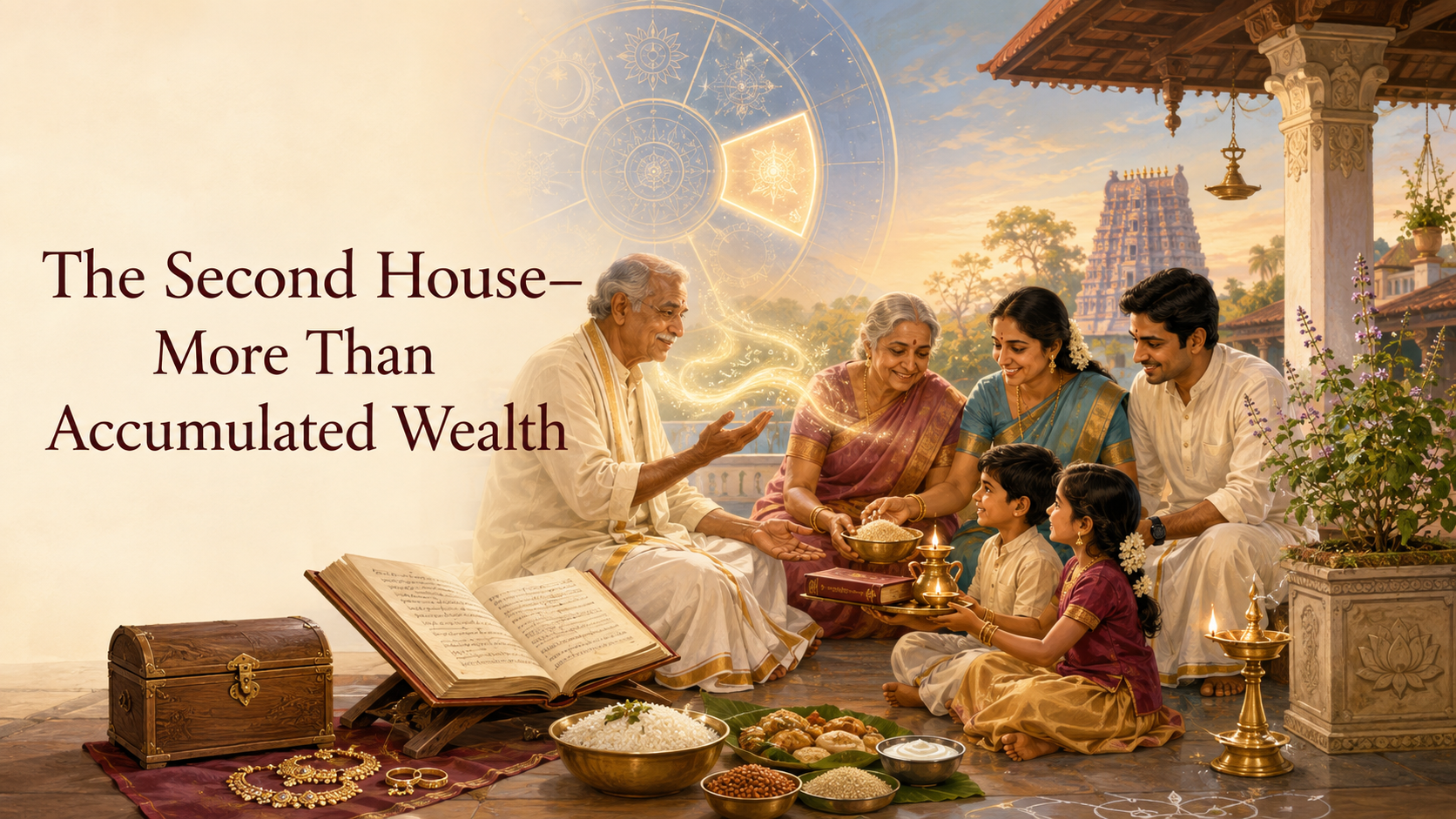
The Second House—More Than Accumulated Wealth
॥ Hari Sarvottama Vāyu Jīvottama ॥
What Are We Truly Preserving?
Jyotiṣa and the Dharma of Wealth | Article 3
Understanding Dhana, Karma and Dāna through Vedic Astrology
In Vedic Astrology, the second Bhāva is commonly known as Dhana Bhāva—the house of wealth.
Naturally, it is examined when assessing income retained, savings, possessions and financial stability. Yet interpreting the second house only through money gives us an incomplete picture.
The second Bhāva also represents:
- Family and lineage
- Food and nourishment
- Speech and expression
- Knowledge and early learning
- Personal and inherited values
- The resources we preserve and pass forward
Its deeper question is therefore not merely:
“How much wealth can we accumulate?”
It is also:
“What do we value, preserve and transmit to the next generation?”
Wealth That Remains with Us
The second house generally represents accumulated wealth rather than every form of income.
The tenth house may describe our work and Karma. The eleventh may indicate gains and the fulfilment of aspirations. The second shows what is gathered, retained and made available for future use.
However, financial accumulation cannot be assessed from the second house alone. A responsible analysis must consider:
- The sign occupying the second house
- The condition and placement of the second lord
- Planets occupying or influencing the house
- Connections with other Dhana and Artha Bhāvas
- Relevant Daśā and Bhukti periods
- The overall strength and promise of the horoscope
The divisional charts and other supporting factors may provide further insight where appropriate.
A benefic planet in the second house does not automatically guarantee riches, just as a difficult influence does not permanently deny financial stability. Jyotiṣa must be interpreted as an integrated whole.
Family—Our First Inherited Wealth
The second Bhāva is associated with Kutumba—the family into which we are born and the environment that shapes our early life.
Long before we earn money independently, we inherit something from our family:
- Language and patterns of speech
- Food habits and customs
- Religious and cultural practices
- Attitudes towards money
- Ideas about generosity and responsibility
- Stories, knowledge and collective memory
Some inherit property. Others inherit education, discipline, devotion, courage or a respected family name.
These may not appear in a bank statement, yet they can influence an entire life.
The second house therefore connects material inheritance with Saṃskāra—the impressions and values carried through the family.
Speech—Wealth Expressed Through Words
The second house governs Vāk—speech.
Words can build trust, resolve conflict, teach knowledge and offer comfort. They can also cause humiliation, division and lasting pain.
A person’s speech may become a source of livelihood through teaching, consultation, counselling, writing, law, music, business or public communication. In this sense, Vāk itself can become a form of Dhana.
The Bhagavad Gītā describes disciplined speech:
अनुद्वेगकरं वाक्यं सत्यं प्रियहितं च यत् ।
स्वाध्यायाभ्यसनं चैव वाङ्मयं तप उच्यते ॥Anudvega-karaṁ vākyaṁ satyaṁ priya-hitaṁ ca yat,
svādhyāyābhyasanaṁ caiva vāṅ-mayaṁ tapa ucyate.
“Speech that does not cause agitation, that is truthful, pleasant and beneficial, together with the regular recitation and study of sacred knowledge, is called austerity of speech.”
— Bhagavad Gītā 17.15
This verse shows that truthful speech alone is not sufficient. It should also be beneficial and expressed without unnecessary harm.
Thus, the condition of the second house may invite us to examine not only how a person speaks, but also how responsibly that gift of speech is used.
Annam—The Wealth That Sustains Life
The second Bhāva is also associated with the mouth, food and nourishment.
This connection reminds us that wealth first fulfils a basic purpose: it sustains life.
The Taittirīya Upaniṣad instructs:
अन्नं न निन्द्यात् । तद्व्रतम् ॥
Annaṁ na nindyāt. Tad vratam.
“Food must not be treated with disrespect. Let this be one’s sacred observance.”
— Taittirīya Upaniṣad 3.7
A household may possess many luxuries, but the ability to provide clean food with dignity and gratitude remains among its most fundamental forms of prosperity.
Our relationship with food also reveals our values:
Do we waste it or respect it?
Do we receive it with gratitude?
Do we remember the Annadātā?
Do we share it with a guest or a hungry person?
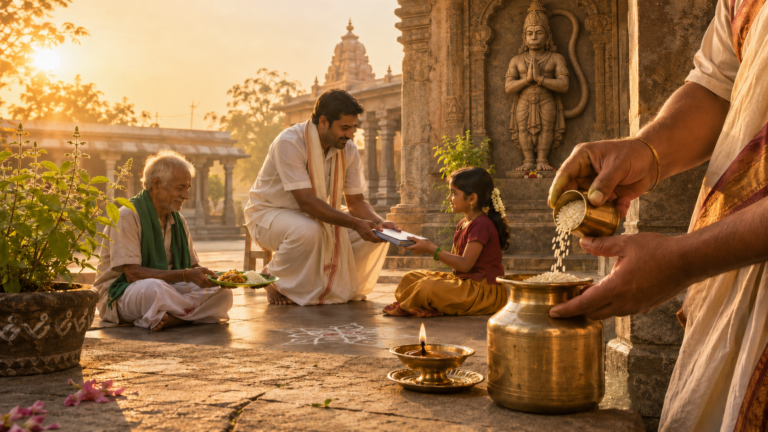
When food is respected and shared, the Dhana represented by the second house begins to serve Dharma.
Knowledge That Cannot Be Taken Away
The second house is also connected with learning, memory and knowledge acquired during the formative years.
Material possessions can be lost. Knowledge, discipline and wisdom often remain with us and help rebuild what has been lost.
A family that invests in education, preserves sacred learning and encourages truthful inquiry creates a form of wealth that can serve many generations.
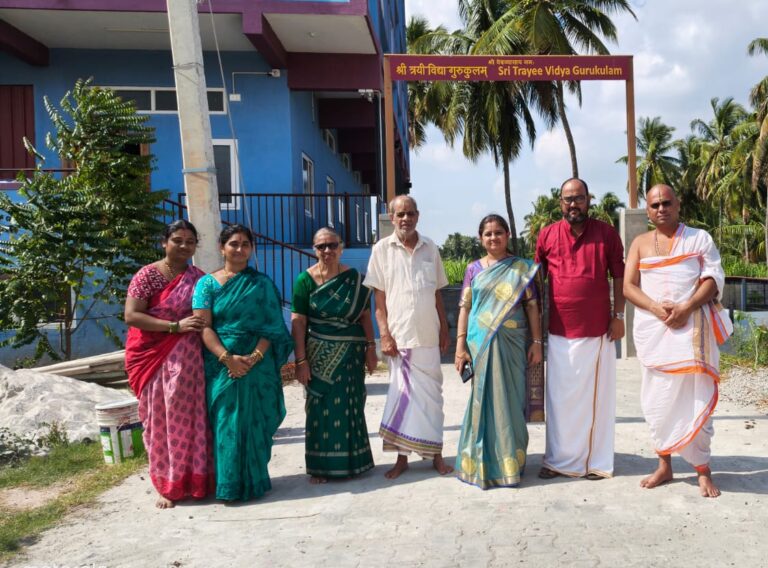
For this reason, Vidyā Dāna occupies a special place in dhārmic life. Supporting a student, teacher, Vedic scholar or Gurukulam is not merely meeting an immediate need—it helps knowledge continue beyond one lifetime.
When Accumulation Becomes Attachment
Because the second house indicates what we preserve, it may also reveal where preservation becomes excessive attachment.
Saving responsibly is wise. A Gṛhastha must prepare for family needs, emergencies, education and future responsibilities.
But accumulation becomes unhealthy when:
- Security turns into constant fear
- Possession becomes the measure of self-worth
- Family wealth creates pride
- Resources are withheld despite genuine need
- Money is preserved while relationships and values are neglected
Dhana should provide stability, not imprisonment.
The purpose of preserving wealth is not merely to keep it untouched, but to ensure that it remains available for rightful needs, responsibilities and Seva.
The Second House as a Mirror of Values
The second house brings several seemingly different subjects together: money, family, food, speech and knowledge.
What connects them?
They are all forms of wealth that we receive, preserve, use and transmit.
We inherit language and values from our family. We receive nourishment through food. We accumulate resources through effort. We preserve knowledge through learning. We transmit all of these through our words and conduct.
The second Bhāva therefore becomes a mirror of what we consider valuable.
A Thought to Carry with Us
When examining the second house, we may ask:
What have I received from my family and Sri Hari’s grace? What am I preserving—and what will I pass forward?
The greatest inheritance we leave behind may not be property alone.
It may be truthful speech.
It may be knowledge.
It may be reverence for food.
It may be devotion and family Saṃskāra.
It may be the habit of sharing willingly with others.
Money is one form of accumulated wealth. But the higher purpose of the second house is revealed when our resources, words, knowledge and family values become instruments of Dharma.
Jyotiṣa shows what we may possess.
Dharma teaches us what deserves to be preserved.
Dāna teaches us what must be shared.
And Sri Hari reminds us that nothing is truly independent of His grace.
॥ Śrī Kṛṣṇārpaṇamastu ॥
Coming Next
Article 4: The Eleventh House—Gains, Desires and Fulfilment
In the next article, we shall explore why achieving our desires does not always produce contentment—and how Jyotiṣa distinguishes between receiving more and feeling fulfilled.
Astrology consultation fees received through AstroYathra support the spiritual, educational, Dāna and Seva initiatives undertaken by Bhaktha Anjaneya Astrology Research and Seva Trust.