Who Truly Owns Our Wealth?
॥ Hari Sarvottama ॥ ॥ Vāyu Jīvottama ॥
The first step in our Dhana–Dharma Yātrā
We often speak of my income, my house, my savings and my success. We work hard, make sacrifices and naturally feel that what we have earned belongs to us.
But the Īśāvāsya Upaniṣad begins by gently challenging this sense of ownership:
ईशावास्यमिदं सर्वं यत्किञ्च जगत्यां जगत् ।
तेन त्यक्तेन भुञ्जीथा मा गृधः कस्य स्विद्धनम् ॥Īśāvāsyam idaṁ sarvaṁ yat kiñca jagatyāṁ jagat;
tena tyaktena bhuñjīthā mā gṛdhaḥ kasya svid dhanam.
Everything within this moving universe is pervaded and governed by the Supreme Lord. Therefore, enjoy what has been allotted to you with restraint and gratitude—without becoming possessive of another’s wealth. (Īśāvāsya Upaniṣad, Mantra 1)
The mantra ends with a profound question:
Kasya svid dhanam? — Whose wealth is it, after all?
The true source of prosperity
In the Madhwa tradition, Śrī Hari is Svatantra—the Supreme Independent Reality. Every jīva and everything within creation exists through His will and remains dependent upon Him.
Our intelligence, health, opportunities, family support and capacity to work are not created by us alone. Human effort is essential, but even the ability to make that effort is sustained by divine grace.
Mahālakṣmī is not merely a deity associated with money. She is the divine embodiment of auspiciousness, nourishment, knowledge, strength and prosperity. Money is only one limited expression of Her abundant grace.
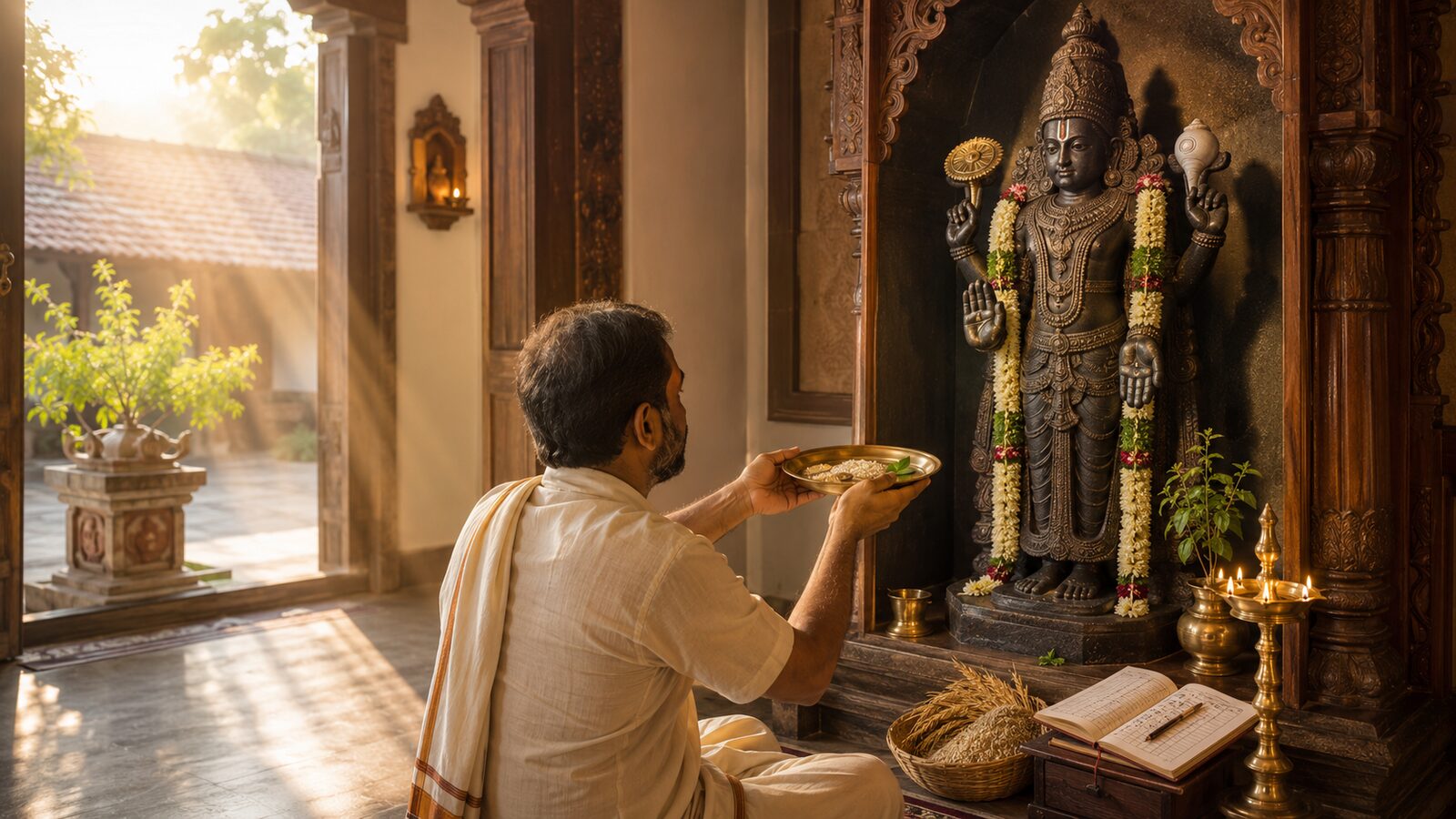
When Dhana enters our lives, we must therefore receive it as Hari–Lakṣmī prasāda—a blessing accompanied by responsibility.
Owners—or custodians?
The śāstric vision does not ask a householder to reject wealth. A gṛhastha must earn honestly, protect the family, educate the children, care for elders, welcome guests and prepare responsibly for the future.
The transformation lies not in abandoning wealth, but in changing our relationship with it.
We may earn it, hold it and administer it—but we are its custodians, not its absolute owners.
A custodian naturally asks:
- How much of this is genuinely necessary?
- Is my wealth being earned through Dharma?
- Does it support only my comfort, or does it also relieve another’s difficulty?
- Will a portion of it nourish Dharma beyond my lifetime?
These questions do not diminish prosperity. They give prosperity a sacred direction.
When enjoyment becomes gratitude
Śrī Kṛṣṇa cautions in the Bhagavad Gītā that one who enjoys the gifts of creation without returning anything is behaving like a thief. (Bhagavad Gītā 3.12)
This does not mean that we should feel guilty while enjoying the fruits of our labour. It means that enjoyment must be accompanied by remembrance and gratitude.
We return a portion through:
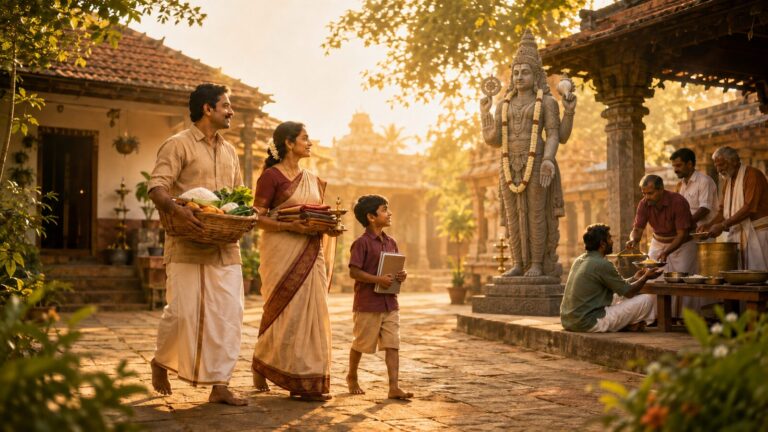
- Anna dāna and assistance to those in need
- Temple seva and protection of sacred traditions
- Education and support for deserving students
- Care for animals, nature and the vulnerable
- Service offered without seeking recognition
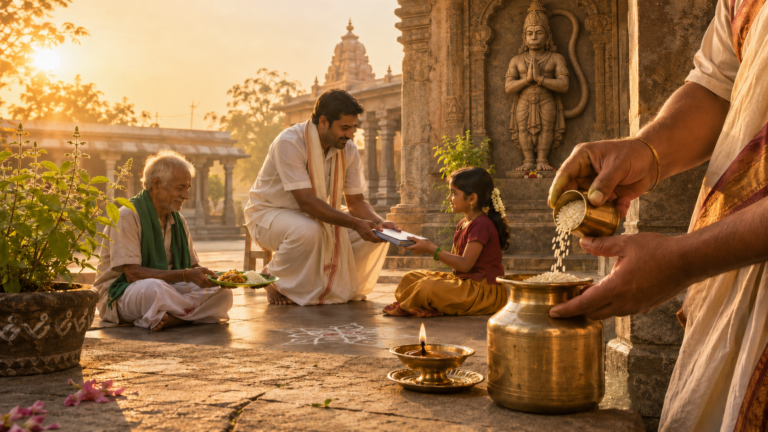
When wealth nourishes another life, it ceases to be merely an asset. It becomes seva.
Dāna is not a financial transaction
True dāna is not the act of a superior person helping someone below them. Both the giver and receiver are participants in a sacred arrangement made possible by Śrī Hari.
The recipient gives us an opportunity to loosen attachment, express gratitude and purify the wealth entrusted to us. Therefore, dāna must be offered with humility—not with pride, publicity or an expectation of repayment.
The Bhagavad Gītā describes as sāttvika that gift which is offered because giving is a duty, at the proper place and time, to a worthy recipient, without expecting anything in return. (Bhagavad Gītā 17.20)
The greatness of an offering is not measured only by its monetary value. A small gift offered with śraddhā may carry greater spiritual depth than a large donation made for recognition.
Let wealth travel towards Dharma
Pause for a moment and think of one blessing that has entered your life—an income, an opportunity, a skill, a comfortable meal or the support of another person.
Did it arrive through your effort alone?
Or were many visible and invisible hands involved in bringing it to you?
This awareness is where Dāna begins.
Wealth need not leave the family to become sacred. It first fulfils Dharma by responsibly nourishing the family. But it must not become imprisoned within the boundaries of “me and mine.” Even a small portion should be allowed to travel further—to feed, educate, protect, heal or preserve Dharma.
Wealth changes hands. Property changes names. What we call ours today will belong to someone else tomorrow. But the Dharma performed through it accompanies the jīva as puṇya and inner refinement.
We may therefore say:
We do not truly own our wealth. We are temporarily entrusted with the privilege of giving it purpose.
Let us receive prosperity with gratitude, preserve it with wisdom, enjoy it with restraint and share it with devotion.
For when Dhana begins to travel in the direction of Dharma, prosperity itself becomes worship.
A thought to carry with us
Before spending or giving, let us quietly ask:
“How can this blessing entrusted to me become pleasing to Śrī Hari?”
That single question can gradually transform possession into purpose—and Dhana into Seva.
To be continued:
Dhana and Dharma—Why They Must Travel Together
Dharma Dīpikā – A Spiritual Journal of Dharma, Dāna and Seva
Bhaktha Anjaneya Astrology Research and Seva Trust
Dharmo Rakṣati Rakṣitaḥ