Dhana and Dharma—Why They Must Travel Together
॥ Hari Sarvottama ॥ ॥ Vāyu Jīvottama ॥
The second step in our Dhana–Dharma Yātrā
In our first article, we reflected upon a fundamental truth: we are not the absolute owners of our wealth. We are custodians entrusted with the responsibility of giving it a worthy purpose.
But purpose requires direction.
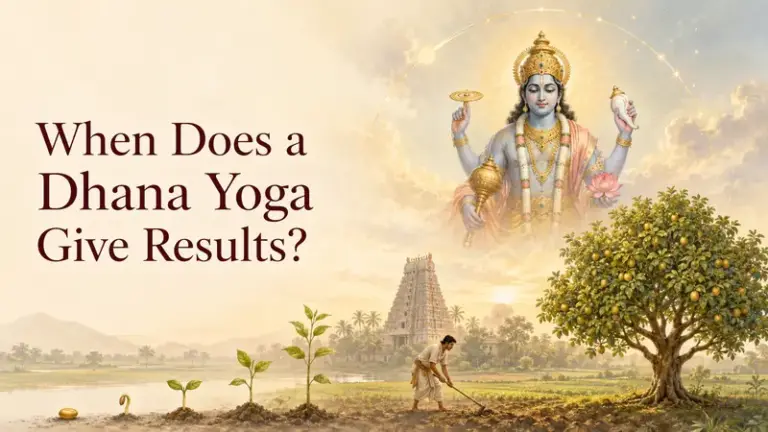
A river sustains life when it flows within its banks. Without direction, the same water can flood and destroy. Dhana is similar. It carries immense power—the power to nourish, educate, protect, build and serve. Yet when separated from Dharma, it can also strengthen greed, pride and attachment.
Dhana is the resource. Dharma must become its direction.
Is the pursuit of wealth wrong?
Sanātana Dharma does not condemn the earning of wealth. Artha—material resources and economic well-being—is recognised as one of the four Puruṣārthas, or legitimate aims of human life:
- Dharma — righteous living
- Artha — material prosperity
- Kāma — legitimate desires
- Mokṣa — spiritual liberation
The order is itself a teaching.
Artha and Kāma are placed after Dharma because both must operate within its boundaries. Prosperity is not rejected; it is disciplined. Enjoyment is not forbidden; it is sanctified through restraint.
Śrī Kṛṣṇa says:
धर्माविरुद्धो भूतेषु कामोऽस्मि भरतर्षभ
Dharmāviruddho bhūteṣu kāmo’smi Bharatarṣabha.
“I am that desire in living beings which is not opposed to Dharma.” (Bhagavad Gītā 7.11)
The problem, therefore, is not desire itself. The question is whether our desires remain aligned with Dharma.
Similarly, wealth is not impure. Its spiritual character is determined by how it is earned, how it is enjoyed and where it is allowed to flow.
When Dhana travels without Dharma
Wealth begins to lose its sacredness when it is:
- Earned through dishonesty or exploitation
- Accumulated without contentment
- Used only to display status
- Enjoyed without gratitude
- Protected at the cost of another’s legitimate need
- Allowed to increase pride and reduce compassion
Such wealth may provide comfort, but it cannot provide lasting inner fulfilment. The possessions surrounding us may increase while the space within the heart gradually becomes smaller.
This is why our śāstras do not measure prosperity merely by accumulation. They examine whether wealth contributes to the higher purpose of life.
The Śrīmad Bhāgavata teaches:
धर्मस्य ह्यापवर्ग्यस्य नार्थोऽर्थायोपकल्पते ।
नार्थस्य धर्मैकान्तस्य कामो लाभाय हि स्मृतः ॥Dharmasya hy āpavargyasya nārtho’rthāyopakalpate;
nārthasya dharmaikāntasya kāmo lābhāya hi smṛtaḥ.
Dharma is meant to elevate the jīva, not merely to produce material gain; and wealth acquired through Dharma is not intended solely for sense gratification. (Śrīmad Bhāgavata 1.2.9)
This teaching does not ask us to neglect worldly life. It asks us not to mistake worldly comfort for life’s final destination.
When Dhana walks with Dharma
Dhana and Dharma begin travelling together when wealth is:
- Earned honestly and without harming others
- Used responsibly for family obligations
- Shared with parents, dependants and guests
- Directed towards education and spiritual growth
- Offered for temple seva and protection of tradition
- Used to feed, heal or support someone in genuine need
- Preserved wisely without becoming an object of attachment
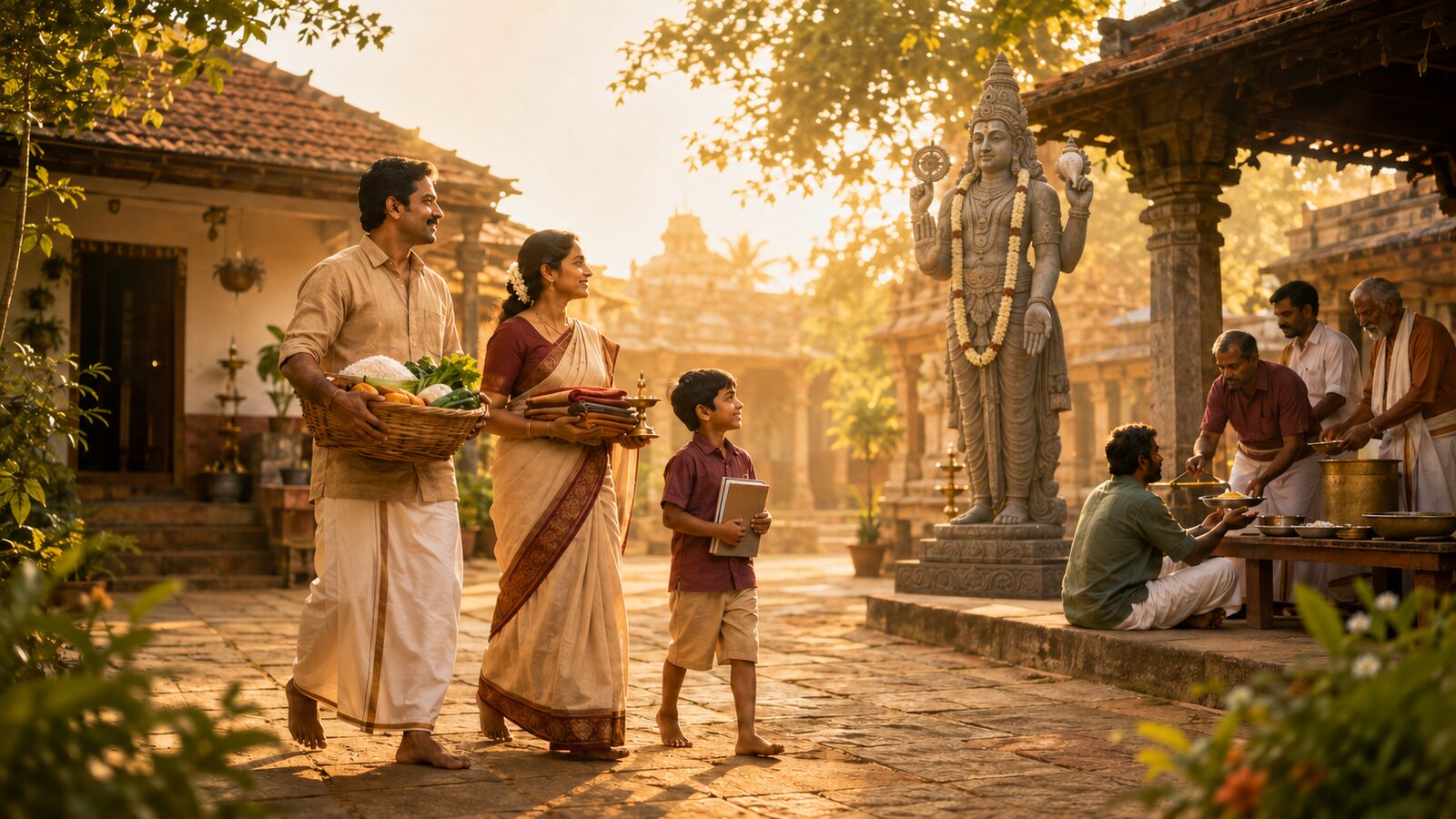
A householder who earns through righteous means, cares for the family and shares with others is not distant from spiritual life. The household itself becomes a centre of Dharma.
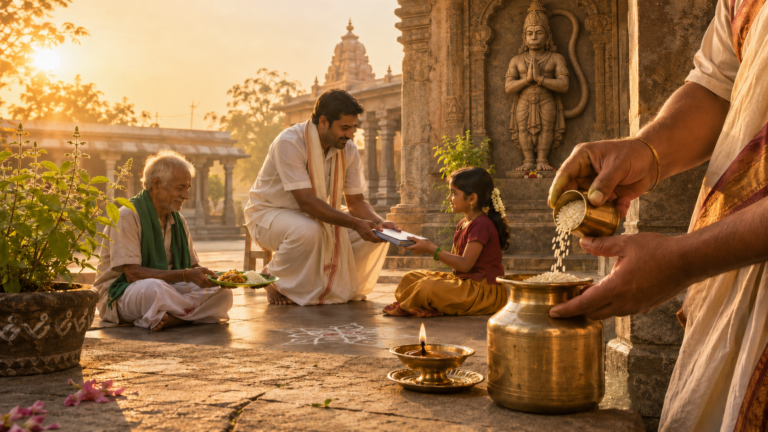
A meal served with gratitude becomes prasāda.
Education provided to a deserving child becomes vidyā dāna.
Support offered to a temple becomes Bhagavat-seva.
Wealth used to relieve suffering becomes compassion in action.
The currency may remain worldly—but its purpose becomes sacred.
The Madhwa vision: everything in the service of Hari
The Madhwa tradition teaches that Śrī Hari alone is fully independent, while every jīva and every power in creation remains dependent upon Him.
Our abilities, possessions and opportunities are therefore not meant to strengthen the illusion of independence. They are instruments through which we may perform our duties and offer service according to our capacity.
This is the spirit of Hari Sarvottama: Śrī Hari is supreme, and every worthy action ultimately finds fulfilment when offered to Him.
We need not abandon prosperity to live spiritually. We must remove the thought that prosperity exists only for us.
When a portion of our Dhana supports Dharma, protects another life or preserves sacred knowledge, it becomes an offering to the Lord dwelling as the inner controller of every being.
Dharma also needs supporting hands
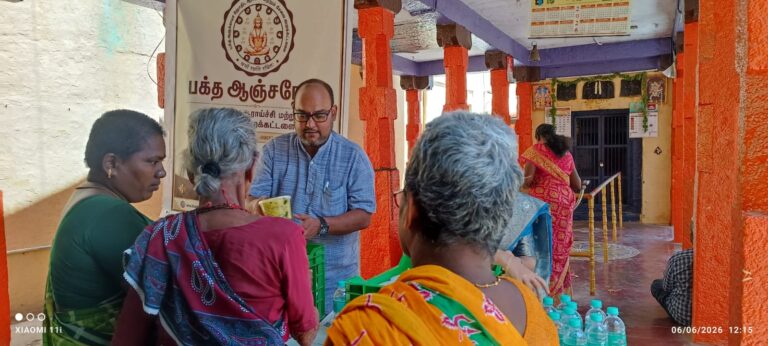
Temples must be maintained. Priests and sincere volunteers require support. Children need education. The hungry must be fed. Ancient knowledge must be studied, taught and preserved. Families facing hardship may need someone to stand beside them.
Good intentions are essential, but many forms of seva also require material resources.
This is where righteous wealth receives a noble opportunity.
Not everyone can offer the same amount. Nor must everyone serve in the same manner. One may offer money, another food, another knowledge, another physical effort and someone else their time.
Dharma does not ask, “How much did you give compared with another?”
It asks, “Did you share sincerely from what was entrusted to you?”
A small decision with a lasting influence
Imagine if every family consciously set aside even a small portion of its income, time or skills for Dharma and seva.
The immediate contribution might appear modest. But children watching such actions would grow up seeing generosity as a natural family value—not as an occasional act performed only during a crisis.
This is how Dharma enters the veins of a family.
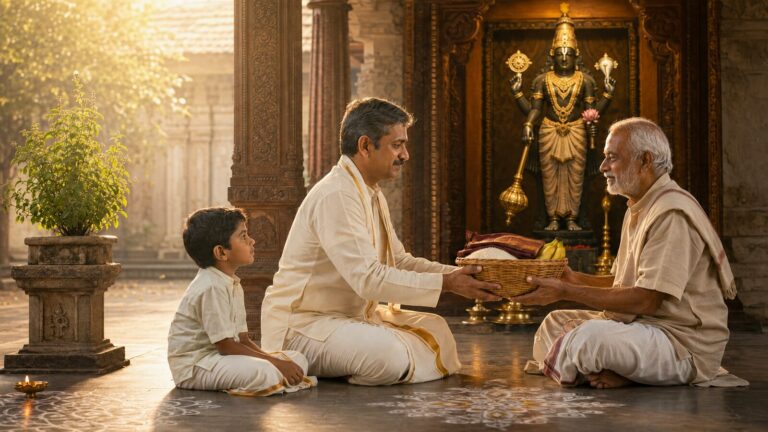
One generation practises it. The next generation inherits it. Society eventually benefits from it.
Our offerings may feed someone for a day, educate a child for a year or support a sacred institution for a period. But the saṃskāra of giving can travel across generations.
Let us examine the direction
Before asking, “How much wealth have I accumulated?” let us also ask:
- Was it earned through Dharma?
- Is it being enjoyed with gratitude?
- Does it fulfil my responsibilities?
- Has any part of it become useful beyond my own household?
- Is it taking me closer to humility and Śrī Hari—or deeper into attachment?
Dhana and Dharma need not stand on opposite sides of life. When rightly understood, they support each other.
Dharma purifies the pursuit of wealth.
Dhana provides strength for acts of Dharma.
Together, they transform prosperity into purposeful living.
Wealth becomes a blessing not merely when it reaches our hands, but when it travels through our hands in the direction of Dharma.
A thought to carry with us
Before our next purchase, investment or offering, let us pause and ask:
“Is my Dhana travelling in a direction that would be pleasing to Śrī Hari?”
When that question becomes part of our daily life, earning becomes responsibility, enjoyment becomes gratitude and giving becomes worship.
To be continued:
Śraddhayā Deyam—Give with Faith
Dharma Dīpikā – A Spiritual Journal of Dharma, Dāna and Seva
Bhaktha Anjaneya Astrology Research and Seva Trust
Dharmo Rakṣati Rakṣitaḥ