
Rāja Yoga and Dhana Yoga—Are They the Same?
॥ Hari Sarvottama ॥ Vāyu Jīvottama ॥
Understanding Position, Influence and Material Prosperity
Jyotiṣa and the Dharma of Wealth – Article 7
The expressions Rāja Yoga and Dhana Yoga are among the most attractive—and frequently misunderstood—terms in Jyotiṣa.
When people hear Rāja Yoga, they may imagine political power, extraordinary fame or a life free from difficulty. When they hear Dhana Yoga, they may expect abundant wealth.
Because position and prosperity often appear together, the two Yogas are sometimes treated as though they mean the same thing.
But they do not.
A Rāja Yoga primarily indicates the potential for elevation, authority, recognition, influence and meaningful achievement.
A Dhana Yoga primarily indicates the potential for income, accumulation, financial opportunity and material prosperity.
They may support one another, but each represents a distinct dimension of life.
Understanding this difference helps us interpret a horoscope realistically—and recognise that neither status nor wealth alone determines the true value of a life.
What Is a Rāja Yoga?
The word Rāja means king, ruler or sovereign.
In earlier times, Rāja Yogas were naturally associated with kingship, royal favor, command over territories and positions of authority. In the modern world, their expression must be understood according to the individual’s Deśa, Kāla and Pātra—place, time and capacity.
A Rāja Yoga today may manifest through:
- Leadership in an organisation
- Professional elevation
- Administrative responsibility
- Public recognition
- Intellectual or spiritual influence
- Authority within an institution
- The ability to guide people or shape decisions
- Success in government, business, education or social service
- Respect earned through expertise
- The capacity to undertake work of wider significance
Therefore, a person need not become a political ruler to experience a Rāja Yoga.
A respected teacher, an accomplished physician, a senior administrator, an influential scholar, a spiritual guide or a person leading an important social initiative may all express different forms of Rāja Yoga.
The essential principle is elevation accompanied by influence and responsibility.
How Is a Rāja Yoga Formed?
The most widely recognised Rāja Yogas arise through favourable relationships between the lords of Kendra and Trikoṇa houses.
The Kendra houses are:
- First House
- Fourth House
- Seventh House
- Tenth House
They represent the principal foundations and visible activities of life.
The Trikoṇa houses are:
- First House
- Fifth House
- Ninth House
They represent the self, intelligence, pūrva-puṇya, Dharma, fortune and blessings.
When the lords of these houses establish a favourable relationship—through conjunction, mutual aspect, exchange or other meaningful association—the strength of action may unite with the support of Dharma and fortune.
This can create the potential for advancement and distinction.
However, as with a Dhana Yoga, merely identifying the combination is not enough. The astrologer must also examine:
- The strength of the planets forming the Yoga
- The houses in which they are placed
- Their dignity by sign
- Benefic and malefic influences
- The condition of their dispositors
- Their relevance to the Lagna
- Their strength in the appropriate divisional charts
- The Daśā periods capable of activating them
A Yoga written in the horoscope must possess sufficient strength and suitable timing to manifest meaningfully.
What Is a Dhana Yoga?
A Dhana Yoga concerns the generation, receipt, preservation or expansion of material resources.
It commonly involves favourable relationships among the lords or significations of houses connected with:
- Accumulated wealth
- Intelligence and merit
- Fortune and blessings
- Profession and productive activity
- Income and gains
The Second and Eleventh Houses are particularly important because they represent accumulation and gain respectively. The Fifth and Ninth may contribute intelligence, pūrva-puṇya, fortune and opportunity, while the Tenth may provide the professional activity through which prosperity is generated.
A Dhana Yoga may operate through employment, enterprise, inheritance, knowledge, property, investments, institutional support, professional networks or other channels indicated by the planets involved.
Its central concern is not necessarily authority or recognition. It is the person’s capacity to attract, generate, retain or manage resources.
The Essential Difference
The distinction may be understood simply:
Rāja Yoga elevates the person’s position.
Dhana Yoga strengthens the person’s material resources.
A person may occupy a highly respected position without possessing extraordinary wealth. Another person may accumulate considerable wealth while remaining outside public attention or formal authority.
Therefore:
| Rāja Yoga | Dhana Yoga |
|---|---|
| Position and elevation | Wealth and material resources |
| Authority and responsibility | Income and accumulation |
| Recognition and influence | Financial opportunity and gain |
| Leadership and achievement | Prosperity and financial capacity |
| Wider impact through one’s role | Wider choice through one’s resources |
The two can coexist, but one should never be assumed merely because the other is present.
Rāja Yoga Without Great Wealth
A strong Rāja Yoga may elevate a person into a position of authority, but the position may not necessarily produce exceptional wealth.
Consider a respected judge, scholar, administrator, temple functionary, teacher or leader of a charitable institution. Such a person may exercise substantial influence and command genuine respect while living with moderate financial means.
The horoscope may support:
- High responsibility
- Recognition within a particular field
- Access to important people
- The power to make decisions
- Public trust
- Leadership over an institution or community
Yet if the houses of wealth, gains and accumulation are weak or afflicted, the person’s financial condition may remain ordinary.
Position creates influence, but it does not automatically create personal wealth.
In some lives, authority itself becomes a form of Seva. The person may be given responsibility not for personal enrichment, but to protect an institution, guide others or uphold Dharma.
Dhana Yoga Without Position or Fame
A strong Dhana Yoga can produce prosperity without bringing public visibility.
A business owner, investor, agricultural landholder, specialised consultant or member of a financially established family may possess substantial resources without occupying a prominent public position.
The person may prefer privacy and have little interest in titles, authority or recognition.
The horoscope may support:
- Consistent income
- Profitable enterprise
- Strong savings
- Valuable property
- Family wealth
- Successful investments
- Supportive financial networks
Yet without corresponding Rāja Yoga influences, the individual may not hold wider authority or receive significant public recognition.
Wealth provides capacity. It does not necessarily provide leadership, wisdom or social influence.
When Both Yogas Work Together
When strong Rāja Yogas and Dhana Yogas operate together, position and resources may reinforce one another.
Leadership may create financial opportunity, while financial strength may expand the person’s capacity to lead, build institutions and support wider causes.
Such a combination may be seen in:
- Successful entrepreneurs
- Senior corporate leaders
- Influential professionals
- Political or administrative figures
- Founders of institutions
- Patrons of education, culture or Dharma
- Individuals whose knowledge brings both recognition and prosperity
Even then, the scale of the result depends on the strength of the entire horoscope.
A modest combination may bring a supervisory role and comfortable income. A stronger combination, supported by the Lagna, Daśā and divisional charts, may produce leadership of a much greater scale.
The term Rāja Yoga should therefore not be used carelessly to promise kingship, celebrity or unlimited success.
The Lagna Must Be Able to Carry the Yoga
Every Yoga ultimately operates through the individual.
A strong Lagna and Lagna lord provide health, confidence, clarity, resilience and the ability to use the opportunities shown elsewhere in the horoscope.
A person may possess favourable combinations but struggle to express them if the Lagna is severely weakened. Opportunities may arise, yet the individual may lack the confidence, health, discipline or judgment required to sustain them.
This is especially important for Rāja Yoga.
Elevation brings pressure. Authority attracts scrutiny. Leadership demands decision-making. Recognition increases responsibility.
The horoscope must therefore be examined not only for the promise of advancement but also for the capacity to carry its weight.
A crown is not merely an ornament. It is also a burden of responsibility.
Daśā Determines When the Yoga Awakens
Neither Rāja Yoga nor Dhana Yoga gives identical results throughout life.
A Yoga becomes more active during the Mahādaśā or Antardaśā of the planets forming it, supporting it or connecting with the relevant houses.
During the activation of a Rāja Yoga, a person may experience:
- Promotion or appointment
- Greater authority
- Recognition of expertise
- Leadership of an important initiative
- Access to influential circles
- Expansion of professional responsibility
- A stronger public or institutional role
During the activation of a Dhana Yoga, the experience may include:
- Increased income
- Business expansion
- Improved savings
- Acquisition of assets
- Profitable opportunities
- Support from patrons or networks
- Greater financial stability
When both are activated together, elevation and prosperity may occur during the same period.
But if only one is activated, a person may receive a title without substantial financial gain—or financial growth without a change in public standing.
Recognition Is Not the Same as Inner Greatness
The Bhagavad Gītā teaches:
यद्यदाचरति श्रेष्ठस्तत्तदेवेतरो जनः ।
स यत्प्रमाणं कुरुते लोकस्तदनुवर्तते ॥Yad yad ācarati śreṣṭhas tat tad evetaro janaḥ,
sa yat pramāṇaṁ kurute lokas tad anuvartate.“Whatever a distinguished person does, others follow. Whatever standard such a person establishes, the world follows.”
— Bhagavad Gītā 3.21
This verse reveals the responsibility hidden within elevation.
When a person is placed in a position of influence, their conduct affects more than their own life. Others observe their choices, repeat their behaviour and accept the standards they establish.
Therefore, Rāja Yoga should not be interpreted merely as personal glory.
Its higher expression lies in using authority to:
- Protect those who depend upon us
- Act with fairness
- Establish ethical standards
- Support knowledge and Dharma
- Create opportunities for others
- Serve without arrogance
- Accept accountability for one’s decisions
Position becomes auspicious only when it is accompanied by character.
Wealth Is Not the Same as Worthiness
Similarly, Dhana Yoga indicates the capacity to receive or manage resources, but it does not automatically indicate wisdom, generosity or contentment.
Wealth can support a family, sustain education, preserve temples, nourish Vidhyārthis, protect cows and enable many forms of Seva.
The same wealth can also intensify pride, fear, attachment or competition.
The Yoga provides the resource. The person’s values determine its direction.
This is why the Second House signifies not only accumulated wealth but also family values and speech. Wealth cannot be separated entirely from the principles through which it is earned, preserved and used.
Dhana becomes truly auspicious when it remains connected with Dharma.
Authority and Wealth Are Both Entrusted Powers
Rāja Yoga grants one form of power: the capacity to influence people, institutions or decisions.
Dhana Yoga grants another: the capacity to direct material resources.
Both are forms of entrusted power.
Neither position nor wealth exists independently of divine order. The Grahas may indicate the channels through which these blessings arise, but they do not act as independent creators of authority or prosperity.
All capacity remains dependent upon Sri Trivikrama, whose sovereignty extends across all worlds.
In the Vāmana Avatāra, the Lord first appeared in a humble form and then, as Trivikrama, encompassed the universe in three strides. This sacred account reminds us that true greatness does not arise from outward display. All territory, position and possession already exist within the Supreme Lord’s domain.
What, then, can human beings claim as absolutely their own?
Our authority is temporary.
Our wealth is temporary.
Our opportunity to use them well is also temporary.
When Rāja Yoga Becomes Dharma
The Bhagavad Gītā teaches that fulfilment may be found by offering one’s own work to the Supreme:
यतः प्रवृत्तिर्भूतानां येन सर्वमिदं ततम् ।
स्वकर्मणा तमभ्यर्च्य सिद्धिं विन्दति मानवः ॥Yataḥ pravṛttir bhūtānāṁ yena sarvam idaṁ tatam,
sva-karmaṇā tam abhyarcya siddhiṁ vindati mānavaḥ.“By worshipping through one’s own work Him from whom all beings arise and by whom the whole universe is pervaded, a person attains fulfilment.”
— Bhagavad Gītā 18.46
This gives Rāja Yoga a deeper meaning.
Leadership can become worship when authority is exercised with justice, humility and responsibility.
Professional influence can become worship when it is used to protect people and improve institutions.
Knowledge can become worship when it guides others without exploiting their trust.
Similarly, Dhana Yoga reaches its higher expression when prosperity supports rightful duties, Dāna and Seva.
Thus, Rāja Yoga and Dhana Yoga need not remain merely worldly combinations. When directed by Dharma, both can become instruments of spiritual responsibility.
The Astrologer’s Responsibility
Both Yogas are easily exaggerated.
It is irresponsible to identify a single favourable combination and announce that the person will become extremely powerful or wealthy.
A careful astrologer must ask:
- How strong are the planets forming the Yoga?
- What houses do they own and occupy?
- Is the Lagna capable of supporting their results?
- Are there afflictions or counteracting combinations?
- In which area of life can the Yoga realistically operate?
- Which Daśā can activate it?
- What scale of result is appropriate to the person’s circumstances?
- Does the Yoga bring responsibility along with success?
A village leader, departmental manager and national administrator may all experience authority—but at very different scales.
Similarly, financial stability, comfortable prosperity and exceptional wealth are not interchangeable.
Jyotiṣa must provide proportion, context and clarity. It should not feed fantasy.
A Thought to Carry with Us
Rāja Yoga may raise our position.
Dhana Yoga may increase our resources.
Dharma determines how we use both.
Authority without humility can become domination.
Wealth without contentment can become bondage.
But authority guided by Dharma can protect many, and wealth directed through Dāna can relieve suffering and sustain worthy causes.
The highest purpose of Rāja Yoga is not to stand above others, but to accept greater responsibility.
The highest purpose of Dhana Yoga is not merely to possess more, but to become capable of giving and serving more.
Position and prosperity may appear to belong to us for a time. In truth, they remain entrusted gifts within the universal sovereignty of Sri Trivikrama.
May we receive elevation without pride, prosperity without attachment, and the wisdom to transform both into Dharma and Seva.
॥ Śrī Kṛṣṇārpaṇamastu ॥
Coming Next
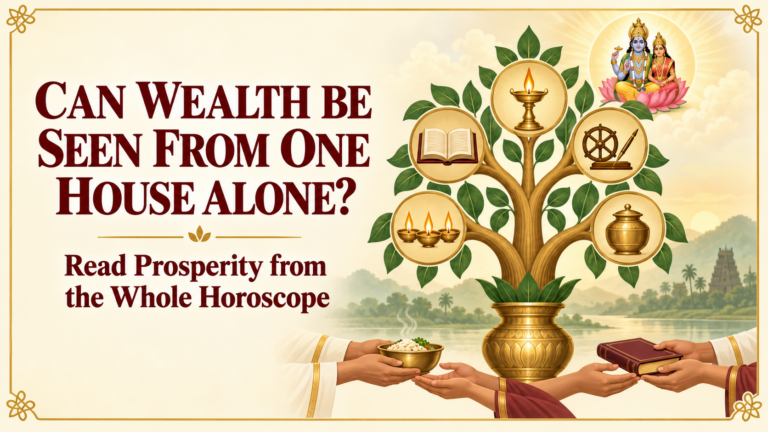
Article 8: Can Wealth Be Seen from One House Alone?
Understanding why the Second, Fifth, Ninth, Tenth and Eleventh Houses must be studied together.
Consultation fees received through AstroYathra support the charitable and dhārmic initiatives of Bhaktha Anjaneya Astrology Research and Seva Trust. Thus, Jyotiṣa becomes a means through which knowledge is transformed into Seva.