When the Last Cup of Water Became Seva
॥ Hari Sarvottama, Vāyu Jīvottama ॥
The Sacred Story of King Rantideva
Jyotiṣa and the Dharma of Wealth – A Purāṇic Reflection
Is Dāna possible only when we possess abundance?
Must we first become wealthy before helping another person?
The story of King Rantideva from the Śrīmad Bhāgavatam gives us a profound answer.
Rantideva’s greatness did not arise from how much he possessed. It emerged from what he was willing to share—even when almost nothing remained.
A King Who Lived for Others
King Rantideva accepted whatever came to him through providence. He did not accumulate wealth for personal comfort. Whenever hungry guests arrived, he offered them what he had.
Over time, he and his family were left with almost nothing.
On one occasion, they remained without food and water for forty-eight days. At last, they received a small quantity of food prepared with milk and ghee, along with some water.
Weak from hunger and trembling with exhaustion, Rantideva and his family prepared to eat.
Just then, a Brāhmaṇa arrived seeking food.
Rantideva welcomed him respectfully and offered him a portion of the meal.
He did not see the guest as an interruption. He saw an opportunity to serve Sri Vāsudeva through one of His dependants.
The Guests Continued to Arrive
After the Brāhmaṇa had eaten and departed, Rantideva divided the remaining food among his family.
As he was about to eat his portion, another hungry traveller arrived.
Once again, the King shared what remained.
A little later, another person appeared, accompanied by hungry dogs. Rantideva welcomed them too and offered them the remaining food.
Nothing was now left to eat.
Only a small cup of water remained—barely enough for one person.
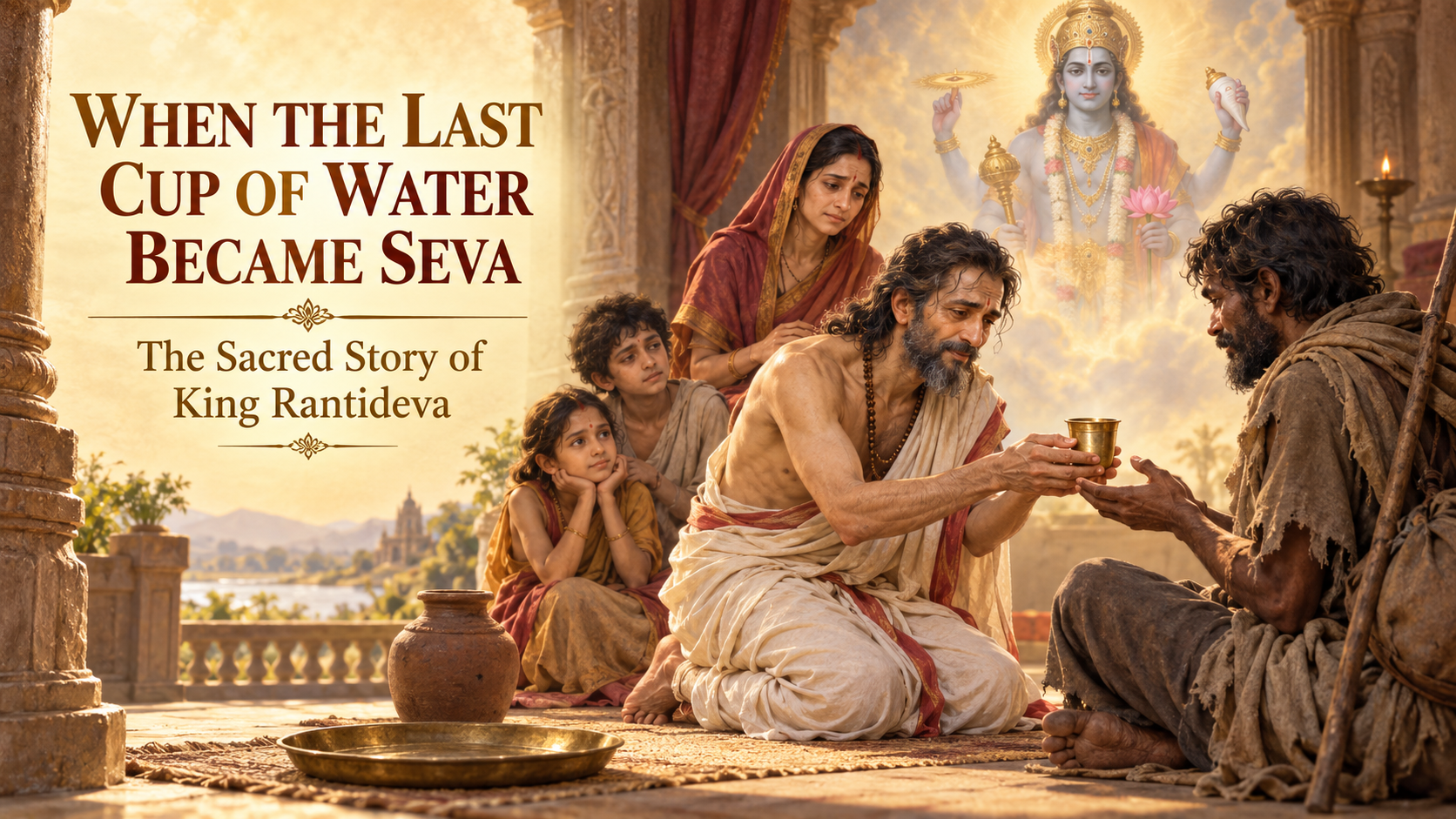
Rantideva had gone without water for forty-eight days. His body was exhausted, and his life itself was in danger. As he lifted the water to drink, another distressed traveller appeared and pleaded for water.
The King looked at the suffering person before him.
He did not calculate whether the stranger deserved the water. He did not ask what reward might arise from giving it. He did not think that his own position as king made his life more valuable.
He simply recognised another being struggling to live.
Rantideva offered him the last cup of water.
The account is narrated in Śrīmad Bhāgavatam 9.21.3–18.
The Prayer of Compassion
Before offering the water, Rantideva expressed one of the most moving prayers found in the Bhāgavatam:
न कामयेऽहं गतिमीश्वरात् परा-
मष्टर्द्धियुक्तामपुनर्भवं वा ।
आर्तिं प्रपद्येऽखिलदेहभाजा-
मन्तःस्थितो येन भवन्त्यदुःखाः ॥Na kāmaye ’haṁ gatim īśvarāt parām
aṣṭarddhi-yuktām apunar-bhavaṁ vā,
ārtiṁ prapadye ’khila-deha-bhājām
antaḥ-sthito yena bhavanty aduḥkhāḥ.
“I do not seek extraordinary powers or even freedom from rebirth. May I remain among living beings and bear their suffering, so that they may become free from distress.”
— Śrīmad Bhāgavatam 9.21.12
Rantideva did not ask for wealth, power, heavenly pleasure or even personal liberation.
His heart had expanded beyond concern for himself.
This is the spirit of true Seva: another person’s suffering is not treated as someone else’s problem.
What Was the Fruit of His Dāna?
After Rantideva offered the water, the visitors revealed that the entire sequence had been a divine test.
The deities appeared before him and were prepared to bless him. Yet Rantideva did not ask them for material benefits.
His mind remained fixed upon Sri Vāsudeva.
The Bhāgavatam explains that illusion could no longer overpower him. His devotion became steady, and those who followed his example were also drawn towards the path of Bhakti.
This was the fruit of his Dāna.
It was not the return of greater wealth.
It was not fame arising from generosity.
It was freedom from selfishness, unwavering devotion and the ability to inspire others towards Dharma.
Dāna Is Not Measured Only by Quantity
One person may donate a large amount without experiencing any sacrifice.
Another may share a single meal that was needed for the family.
The monetary value of the two offerings may be very different. But Dharma also considers:
- The intention behind the offering
- The sacrifice involved
- The worthiness and urgency of the need
- The humility with which it is given
- The absence of expectation
- The compassion present in the heart
Rantideva’s final offering contained only water.
Yet it carried the weight of his hunger, thirst, compassion and complete surrender.
The object given was small.
The spirit of the offering was immeasurable.
Dāna Becomes Seva Through Compassion
Dāna may begin with giving an object.
Seva begins when we recognise the person receiving it.
A hungry person does not merely need food to be treated with dignity.
A student does not merely need books. The child needs encouragement and an opportunity to learn.
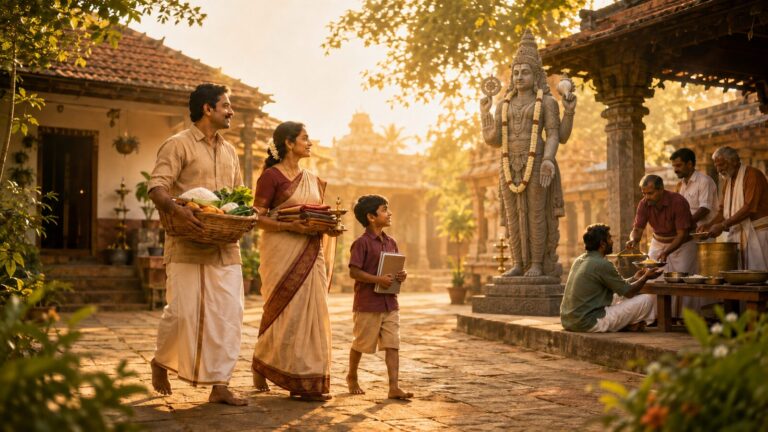
A neglected temple may require financial support, but it may also need people willing to clean, organise and participate.
Go Samrakṣaṇa is not fulfilled merely by making a contribution. It requires concern for the continuing nourishment and protection of the animals.
Seva asks us to see the life, need and dignity behind the request.
Rantideva did not simply give water. He felt the suffering of the person who stood before him.
The Madhwa Understanding
From the Madhwa perspective, the Lord and the jīvas are eternally distinct. Seeing the Divine connection within every being does not mean that the jīva becomes identical with the Supreme.
Rather, every jīva exists in complete dependence upon Sri Vāsudeva.
Therefore, serving a suffering being becomes sacred because that being belongs to Him, is sustained by Him and exists within His divine order.
Rantideva saw his guests in relationship with Sri Vāsudeva. His compassion was therefore not merely emotional kindness. It was Bhakti expressed through action.
Seva performed with this understanding does not place the giver above the receiver.
The giver, the receiver, the resource and the opportunity to serve are all dependent upon the grace of Sri Vāsudeva.
What This Story Teaches Us Today
Most of us may never face a test as severe as Rantideva’s.
But we encounter smaller choices every day:
- Do we share only what is left after satisfying every desire?
- Do we notice a need when no one publicly recognises our contribution?
- Do we offer our time as willingly as we offer money?
- Do we treat beneficiaries with dignity?
- Do we expect gratitude, praise or spiritual merit in return?
- Can we see Seva as an opportunity received rather than a favour performed?
We need not imitate Rantideva’s physical suffering. Dharma does not ask us to neglect legitimate responsibilities towards our health and family.
His story teaches us something deeper: generosity begins when another person’s need finds a place within our heart.
Jyotiṣa, Dāna and Seva
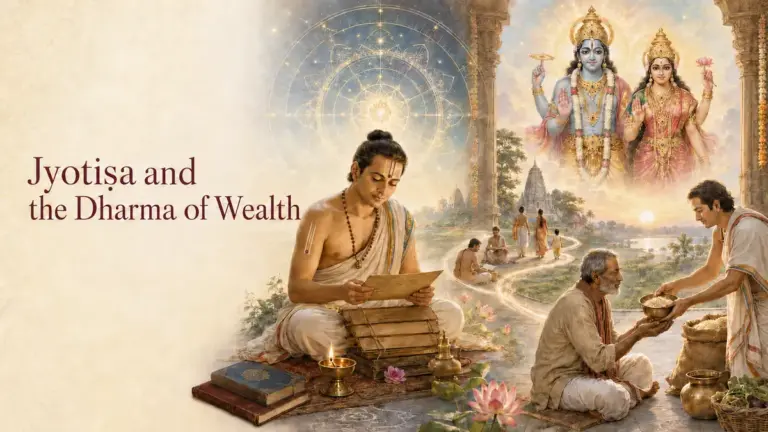
Jyotiṣa may indicate periods of prosperity, financial strength or the capacity to accumulate resources.
But the horoscope cannot compel generosity.
That choice belongs to the individual.
Astrology fulfils a higher purpose when it encourages gratitude, responsibility and compassionate action. A favourable Dhana Yoga becomes spiritually meaningful when some part of the prosperity it produces supports Dharma and reduces suffering.
Likewise, knowledge received through Jyotiṣa can itself become Seva—when it offers clarity without fear, guidance without exploitation and hope without false promises.
When consultation supports a student, feeds someone in need, protects a cow or assists a temple, knowledge begins to circulate as compassionate action.
A Thought to Carry with Us
Rantideva did not wait for abundance before serving.
He gave food when he was hungry.
He gave water when he was thirsty.
And he offered compassion when he himself was suffering.
His story reminds us:
Dāna is not determined by how much remains in our hands. It is revealed by how much compassion lives in our hearts.
The highest fruit of giving is not that more may return to us.
Its highest fruit is that selfishness gradually leaves us.
When Dāna is offered without pride, it becomes Seva.
When Seva is performed with devotion, it becomes Bhakti.
And when Bhakti fills the heart, every opportunity to serve is recognised as the grace of Sri Vāsudeva.
॥ Śrī Kṛṣṇārpaṇamastu ॥
Coming Next
Article 9: Can Dhana Yoga and Financial Difficulties Coexist?
Understanding why prosperity and financial challenges may appear in the same horoscope.
Consultation fees received through AstroYathra support the spiritual, educational, Dāna and Seva initiatives of Bhaktha Anjaneya Astrology Research and Seva Trust. Thus, the guidance offered through Jyotiṣa continues its journey as service to society.