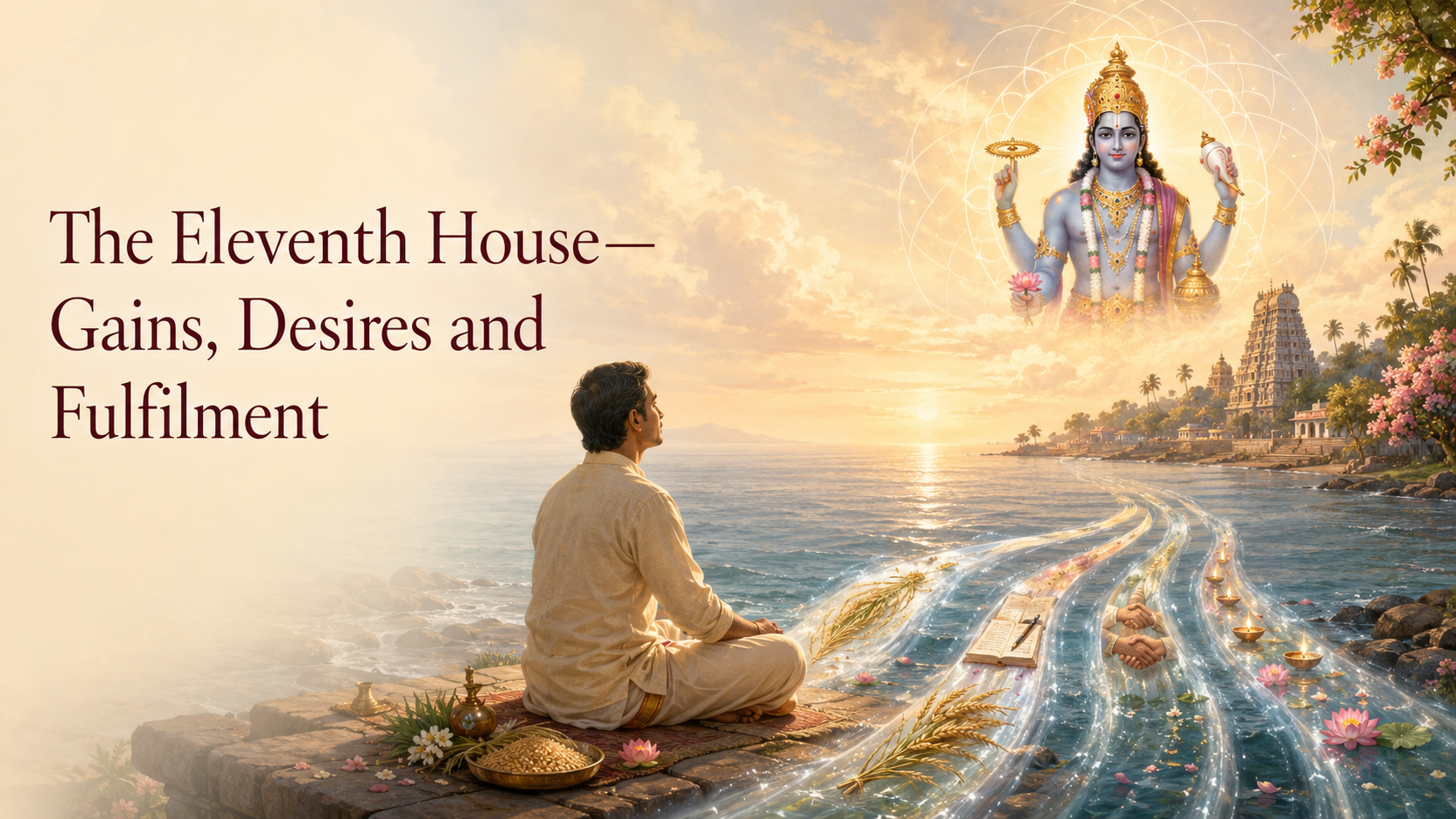
The Eleventh House—Gains, Desires and Fulfilment
॥ Hari Sarvottama Vāyu Jīvottama ॥
Does Receiving More Make Us Feel Complete?
Jyotiṣa and the Dharma of Wealth | Article 4
Understanding Dhana, Karma and Dāna through Vedic Astrology
In Vedic Astrology, the eleventh Bhāva is known as Lābha Bhāva—the house of gains.
It is associated with income, profits, recognition, social networks, elder siblings, aspirations and the fulfilment of desires. Understandably, it receives considerable attention whenever financial prosperity is examined.
Yet the eleventh house raises a deeper question:
If our desires are fulfilled, does that necessarily make us content?
Gaining something and feeling complete are not always the same experience.
What the Eleventh House Represents
The eleventh Bhāva may indicate:
- Income and financial gains
- Profits from work, enterprise or investment
- Rewards arising from our efforts
- Friends, communities and influential networks
- Support from groups and organisations
- Elder siblings
- Recognition and achievement
- Long-term aspirations
- Fulfilment of desires
The tenth house represents Karma, profession and visible responsibility. The eleventh often shows the gains and recognition that arise from those activities.
The second house indicates what we accumulate and preserve. The eleventh indicates what flows towards us as gain.
A person may earn well through the eleventh house but retain little if the second house is weak or financial habits are unstable. Similarly, accumulated wealth may exist without frequent gains.
Both Bhāvas must therefore be understood together.
An Upacaya Bhāva—Growth Through Time and Effort
The eleventh house is one of the Upacaya Bhāvas—houses whose significations can grow and develop over time.
This often indicates that gains, networks and opportunities improve through sustained effort, maturity and experience. What is unavailable in the early years may become possible later through discipline and stronger social or professional connections.
However, growth is not automatic.
The eleventh lord, planets occupying the house, planetary aspects, connections with the second and tenth houses, and the relevant Daśā periods must all be examined.
A strong eleventh house may create opportunities for considerable gain. But it does not independently tell us:
- Whether the wealth will be preserved
- Whether it will be earned ethically
- Whether it will bring peace
- Whether the desires pursued are beneficial
- How the resources will ultimately be used
For those answers, the entire horoscope—and the person’s Dharma—must be considered.
The House of Desire
The eleventh is also a Kāma Bhāva. It shows what we aspire to obtain and the satisfaction experienced when a goal is achieved.
Desire itself is not inherently wrong.
The desire to educate one’s children, build a secure home, support parents, advance professionally or contribute to a dhārmic cause can motivate constructive action.
But desire has a tendency to expand.
One achievement may immediately create another expectation. One financial target may be replaced by a larger one. Recognition may lead to the desire for still greater recognition.
The Bhagavad Gītā describes uncontrolled desire as difficult to satisfy:
आवृतं ज्ञानमेतेन ज्ञानिनो नित्यवैरिणा ।
कामरूपेण कौन्तेय दुष्पूरेणानलेन च ॥Āvṛtaṁ jñānam etena jñānino nitya-vairiṇā,
kāma-rūpeṇa Kaunteya duṣpūreṇānalena ca.
“Knowledge is covered by this constant enemy of the wise, appearing in the form of desire, which is as difficult to satisfy as fire.”
— Bhagavad Gītā 3.39
Fire does not become satisfied merely because more fuel is added. In the same way, desire without discernment may grow through fulfilment rather than disappear.
Preyas and Śreyas—Pleasant or Truly Beneficial?
The Kaṭha Upaniṣad distinguishes between Preyas, that which is immediately pleasant, and Śreyas, that which leads to lasting good:
श्रेयश्च प्रेयश्च मनुष्यमेतस्तौ सम्परीत्य विविनक्ति धीरः ।
श्रेयो हि धीरोऽभि प्रेयसो वृणीते प्रेयो मन्दो योगक्षेमाद्वृणीते ॥Śreyaś ca preyaś ca manuṣyam etas tau samparītya vivinakti dhīraḥ,
śreyo hi dhīro ’bhi preyaso vṛṇīte preyo mando yoga-kṣemād vṛṇīte.
“Both the beneficial and the pleasant approach the human being. The wise examine and distinguish between them. The wise choose the beneficial over the merely pleasant, while the undiscerning choose the pleasant for the sake of acquisition and security.”
— Kaṭha Upaniṣad 1.2.2
This distinction is important when interpreting the eleventh house.
Jyotiṣa may indicate that a desire can be fulfilled. Dharma asks whether that desire deserves to be pursued.
Not everything obtainable is beneficial. Not every profitable opportunity is righteous. Not every ambition contributes to peace.
Gains Through Relationships and Society
The eleventh house also governs friends, communities and networks.
Very little prosperity is created entirely in isolation. Opportunities often arise through:
- Teachers and mentors
- Friends and colleagues
- Customers and clients
- Professional communities
- Family and social connections
- Institutions and collective efforts
Therefore, Lābha is not merely personal income. It is also the support and opportunity that flow through relationships.
This brings responsibility.
Networks should not be cultivated only for personal advantage. Relationships based purely on usefulness become transactional and fragile. Genuine goodwill, trust and mutual contribution create a more dhārmic form of social wealth.
Gains Without Gratitude
When gains arrive repeatedly, the mind may begin to consider them an entitlement.
Gratitude is replaced by expectation. Enough is no longer enough. The blessings already present become invisible because attention remains fixed on the next acquisition.
The Bhagavad Gītā offers the image of the ocean:
आपूर्यमाणमचलप्रतिष्ठं समुद्रमापः प्रविशन्ति यद्वत् ।
तद्वत्कामा यं प्रविशन्ति सर्वे स शान्तिमाप्नोति न कामकामी ॥Āpūryamāṇam acala-pratiṣṭhaṁ samudram āpaḥ praviśanti yadvat,
tadvat kāmā yaṁ praviśanti sarve sa śāntim āpnoti na kāma-kāmī.
“As waters enter the ever-full and steady ocean without disturbing it, so the person into whom desires enter without causing agitation attains peace—not the one who continually longs to satisfy desires.”
— Bhagavad Gītā 2.70
Contentment does not mean abandoning ambition or refusing progress. It means remaining inwardly steady whether a particular gain arrives or not.
In this context, the name Achyuta carries special significance. It means the One who never falls, deviates or loses His eternal perfection. Remembering Sri Achyuta reminds us to seek inner steadiness even while the circumstances around us continue to change.
When Lābha Becomes Seva
The true value of gain is revealed through its direction.
Income may provide security for the family. Networks may help connect a person in need with someone who can assist. Professional success may create the capacity to support education, temples, Gurukulams, Go Samrakṣaṇa or other forms of Seva.
When a portion of our gain is offered willingly towards a worthy purpose, Lābha is transformed into Dāna.
Wealth then stops being merely something received. It becomes something that circulates through Dharma.
The Madhwa Understanding
From the Madhwa perspective, the jīva, the Grahas and all material resources remain eternally dependent upon Sri Achyuta.
The eleventh house may indicate the channels through which gains arise, but the Grahas are not independent creators of prosperity. They function within the divine order governed by Sri Achyuta.
Effort is necessary. Astrological timing may create opportunities. Relationships may open doors. Yet the capacity to act and the fruits that finally arise remain subject to the will and grace of Sri Achyuta.
This understanding protects success from becoming pride.
A Thought to Carry with Us
When a desire is fulfilled, we may pause and ask:
Has this gain made me more grateful, responsible and useful—or has it merely created another desire?
The eleventh house shows what may come towards us.
Dharma determines what deserves to be pursued.
Contentment allows us to enjoy without becoming dependent.
Dāna keeps gain in circulation.
And Seva transforms personal fulfilment into shared welfare.
The purpose of Lābha is not merely to receive more. Its higher possibility is to recognise the grace of Sri Achyuta in what we receive—and to use it meaningfully.
॥ Śrī Kṛṣṇārpaṇamastu ॥
Coming Next
Article 5: What Is a Dhana Yoga?
In the next article, we shall explore how combinations for prosperity are formed, why no single placement guarantees wealth, and why a Dhana Yoga must always be assessed along with planetary strength, Daśā, effort, Karma and divine grace.
Astrology consultation fees received through AstroYathra support the spiritual, educational, Dāna and Seva initiatives undertaken by Bhaktha Anjaneya Astrology Research and Seva Trust.