The Four Puruṣārthas—Where Does Wealth Belong?
॥ Hari Sarvottama Vāyu Jīvottama ॥
Artha Must Travel Under the Guidance of Dharma
Jyotiṣa and the Dharma of Wealth | Article 2
Understanding Dhana, Karma and Dāna through Vedic Astrology
Sanātana Dharma does not teach us to reject wealth. Nor does it consider the desire for security, comfort and progress inherently unspiritual.
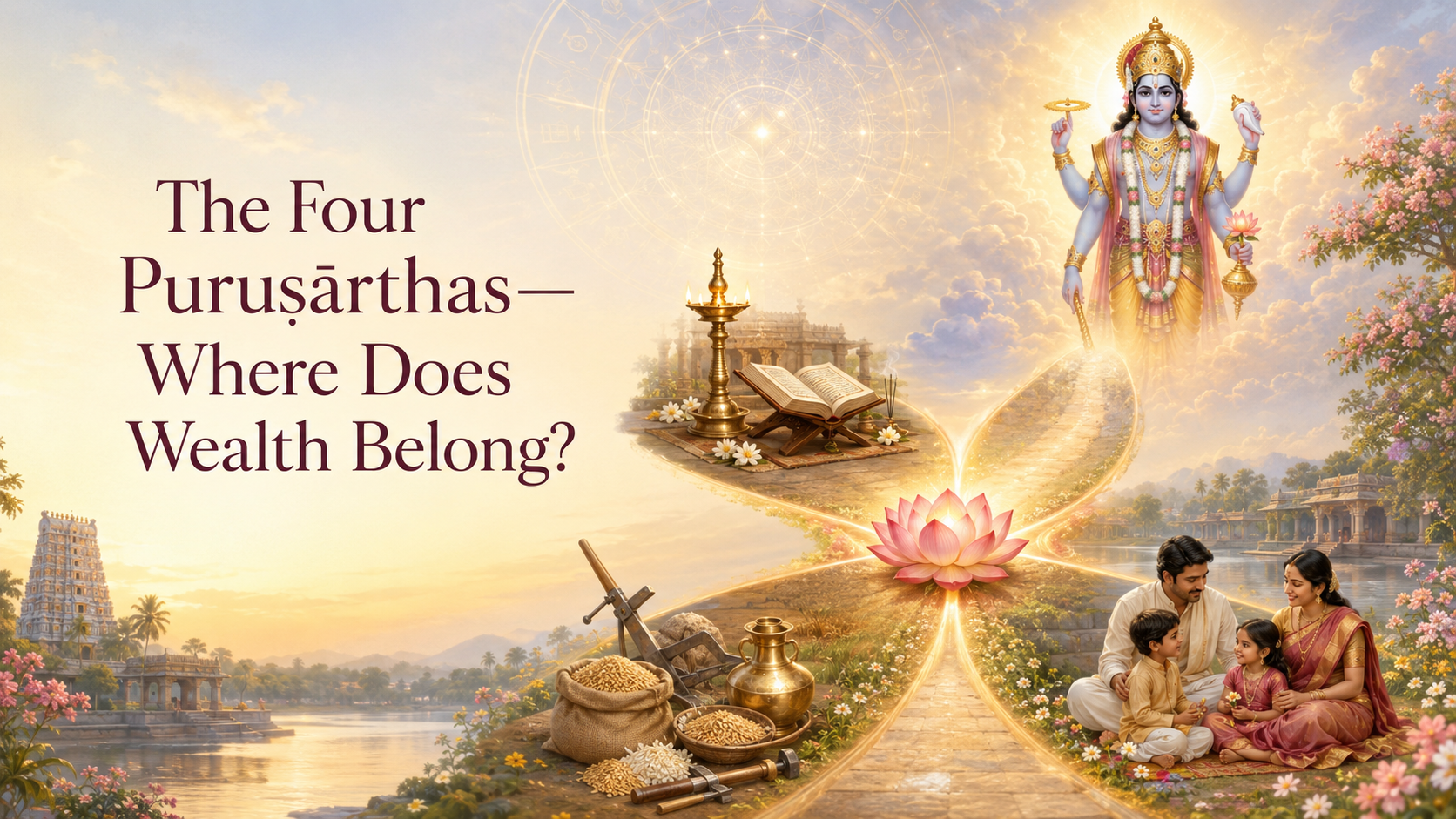
Instead, it places human aspirations within a balanced framework known as the four Puruṣārthas—the four legitimate aims of human life:
- Dharma — righteous conduct, responsibility and alignment with the divine order
- Artha — material resources, livelihood, stability and prosperity
- Kāma — legitimate desires, relationships, enjoyment and emotional fulfilment
- Mokṣa — liberation from bondage and the attainment of the highest spiritual goal
Each has a rightful place. Difficulty arises when one aim is pursued without regard for the others—especially when Artha and Kāma become separated from Dharma.
Dharma—The Guiding Principle
Dharma is placed first because it gives direction to the other pursuits.
It teaches us how wealth should be earned, how desires should be regulated, how responsibilities should be fulfilled and how our choices affect others.
The Mahābhārata conveys this forcefully:
ऊर्ध्वबाहुर्विरौम्येष न च कश्चिच्छृणोति मे ।
धर्मादर्थश्च कामश्च स किमर्थं न सेव्यते ॥Ūrdhva-bāhur viraumy eṣa na ca kaścic chṛṇoti me,
dharmād arthaś ca kāmaś ca sa kimarthaṁ na sevyate.
“With my arms raised, I cry aloud, yet no one listens to me: from Dharma arise both Artha and Kāma. Why, then, is Dharma not followed?”
— Mahābhārata, Svargārohaṇa Parva
This verse does not condemn prosperity or enjoyment. It teaches that both become meaningful and sustainable when they arise through Dharma.
Wealth earned dishonestly may create temporary comfort, but it also carries fear, instability and harmful consequences. Desire pursued without restraint may provide momentary pleasure while increasing attachment and dissatisfaction.
Dharma protects both the individual and society from such imbalance.
Artha—The Resources Required for Life
Artha includes money, property, livelihood, professional abilities, social resources and the practical means required to fulfil our responsibilities.
For a Gṛhastha, Artha is especially important. A Gṛhastha must:
- Provide food, shelter and security for the family
- Educate and guide the children
- Care for elders and dependants
- Welcome and feed guests
- Support temples, Gurukulams and dhārmic institutions
- Assist those facing genuine need
- Contribute towards the welfare of society
These duties cannot always be fulfilled through good intentions alone. They require resources.
Therefore, earning wealth through honest work, knowledge, enterprise or service can itself become part of Dharma.
The Bhagavad Gītā teaches:
यतः प्रवृत्तिर्भूतानां येन सर्वमिदं ततम् ।
स्वकर्मणा तमभ्यर्च्य सिद्धिं विन्दति मानवः ॥Yataḥ pravṛttir bhūtānāṁ yena sarvam idaṁ tatam,
svakarmaṇā tam abhyarcya siddhiṁ vindati mānavaḥ.
“By worshipping Him through one’s own work—from whom all beings arise and by whom everything is pervaded—a person attains fulfilment.”
— Bhagavad Gītā 18.46
Work need not remain separate from spiritual life. When performed honestly, responsibly and as an offering to Sri Hari, one’s profession can become a form of worship.
Kāma—Desire Within the Boundaries of Dharma
Kāma includes affection, relationships, beauty, enjoyment and the legitimate desire to experience happiness.
Sanātana Dharma does not demand that a Gṛhastha abandon every comfort. Food, family life, art, celebration and recreation all have their place.
But Kāma must not control the individual.
When desire governs Dharma, we begin to justify wrongdoing for the sake of pleasure. When Dharma governs desire, enjoyment remains balanced and does not harm ourselves or others.
The purpose is neither indulgence nor forced denial—it is disciplined and grateful enjoyment.
Mokṣa—The Highest Direction
Mokṣa is liberation from the bondage of Karma and repeated worldly existence. It is the highest Puruṣārtha because it addresses the soul’s ultimate spiritual destiny.
From the Madhwa perspective, the jīva remains eternally distinct from Sri Hari. Mokṣa is attained through true knowledge, Bhakti, righteous living and, ultimately, the grace of Sri Hari.
Material wealth cannot purchase Mokṣa.
Yet wealth can support the journey when it is used to sustain worship, learning, Guru Seva, pilgrimage, Dāna and the protection of Dharma. Artha is not the destination, but it can become a valuable instrument along the path.
A Deeper Warning About Wealth and Desire
The Śrīmad Bhāgavatam explains:
धर्मस्य ह्यापवर्ग्यस्य नार्थोऽर्थायोपकल्पते ।
नार्थस्य धर्मैकान्तस्य कामो लाभाय हि स्मृतः ॥Dharmasya hy āpavargyasya nārtho ’rthāyopakalpate,
nārthasya dharmaikāntasya kāmo lābhāya hi smṛtaḥ.
“Dharma is meant for liberation, not merely for material gain. Material gain is not intended solely for sense enjoyment.”
— Śrīmad Bhāgavatam 1.2.9
The next verse continues:
कामस्य नेन्द्रियप्रीतिर्लाभो जीवेत यावता ।
जीवस्य तत्त्वजिज्ञासा नार्थो यश्चेह कर्मभिः ॥Kāmasya nendriya-prītir lābho jīveta yāvatā,
jīvasya tattva-jijñāsā nārtho yaś ceha karmabhiḥ.
“Desire should not be directed merely towards gratification of the senses. One should accept what is necessary to sustain life, while the true purpose of human life is inquiry into spiritual truth.”
— Śrīmad Bhāgavatam 1.2.10
These verses establish the proper order:
Dharma guides Artha.
Artha responsibly supports Kāma.
And the entire life remains directed towards spiritual understanding and Mokṣa.
The Four Puruṣārthas in Jyotiṣa
The twelve Bhāvas of the horoscope are also traditionally grouped according to the four Puruṣārthas:
- Dharma Bhāvas: 1st, 5th and 9th
- Artha Bhāvas: 2nd, 6th and 10th
- Kāma Bhāvas: 3rd, 7th and 11th
- Mokṣa Bhāvas: 4th, 8th and 12th
This arrangement shows that life cannot be judged through one house alone.
The Artha Bhāvas may indicate resources, work and material stability. But their results must be understood alongside the Dharma Bhāvas, which reveal values, intelligence, past merit, Guru and righteous direction.
Similarly, the Kāma Bhāvas show desire, relationships and fulfilment, while the Mokṣa Bhāvas turn our attention towards inner peace, surrender, transformation and liberation.
A horoscope is therefore not merely a map of events. It reflects the interwoven purposes through which a life unfolds.
When the Balance Is Lost
A life focused only on Artha may accumulate possessions but lose peace.
A life driven only by Kāma may continually seek satisfaction but never experience contentment.
Dharma without practical responsibility may remain only an ideal.
And speaking of Mokṣa while neglecting one’s worldly duties is not true renunciation.
The four Puruṣārthas are not isolated compartments. They must support one another in the correct order.
A Thought to Carry with Us
When seeking wealth, we may ask:
Is the way I earn aligned with Dharma? Does my wealth fulfil genuine responsibilities? Do my desires remain within healthy limits? And does my life retain a higher spiritual direction?
Artha has an honourable and necessary place in human life—but it was never intended to become the sole purpose of life.
Dharma gives wealth its direction.
Dāna loosens our attachment to it.
Seva gives it a sacred purpose.
And devotion reminds us that Sri Hari alone is the source, governor and ultimate goal of every worthy pursuit.
॥ Śrī Kṛṣṇārpaṇamastu ॥
Coming Next
Article 3: The Second House—More Than Accumulated Wealth
In the next article, we shall explore why the second Bhāva represents not only money, but also family, food, speech, knowledge and the values we preserve.
Astrology consultation fees received through AstroYathra support the spiritual, educational, Dāna and Seva initiatives undertaken by Bhaktha Anjaneya Astrology Research and Seva Trust.